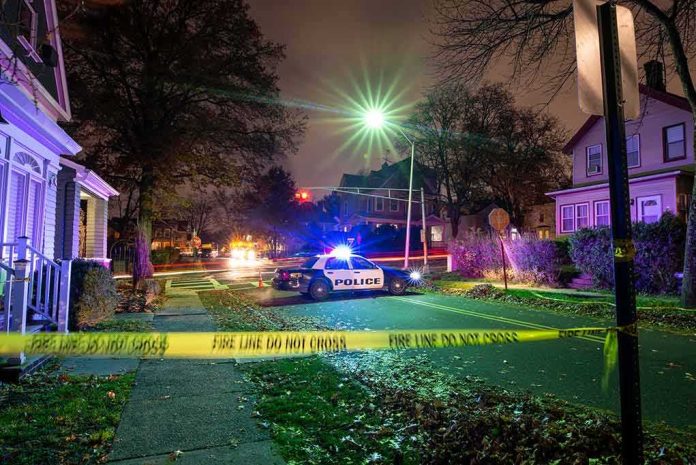
Police say a family dinner in Albuquerque ended with a cousin shot dead after an argument over spicy enchiladas.
Story Snapshot
- Albuquerque police arrested 22-year-old Ervin Gutierrez after his cousin, 25-year-old Nathaniel Cavazos, was shot and killed.
- Reports say the two argued about the heat of green chile, fought, and then Gutierrez fired multiple shots.
- Court records and an arrest warrant describe Cavazos trying to walk away before the gunfire.
- City homicide logs list an arrest in the case, and a murder charge is filed while the court process unfolds.
Police Account of the Dinner Dispute and Shooting
Albuquerque police responded to a northeast complex after reports of gunfire on August 27. Officers found 25-year-old Nathaniel Cavazos dead at the scene. Reporters, citing police, say 22-year-old Ervin Gutierrez argued with Cavazos over how hot the green chile was on their enchiladas. After a fight, Gutierrez pulled a handgun and fired several times, killing Cavazos, according to local coverage of the police account. The City of Albuquerque homicide page notes an arrest in the case tied to that address.
NBC, citing an arrest warrant affidavit, reports the evening involved drinking and a fistfight before shots were fired. The affidavit quotes Gutierrez claiming he did not want to kill Cavazos and feared being killed himself. That quote signals a likely self-defense claim later in court. However, the same reporting ties the shooting to the end of the fight, not to an ongoing attack by Cavazos, which will matter for prosecutors and the defense.
Court Records and What They Do—and Do Not—Show
KOAT reports that court records say Cavazos tried to walk away after the fight. Gutierrez then pulled a gun and shot him at least once, with the victim dying at the scene, according to that outlet’s summary of the case file. Police booked Gutierrez into the Metropolitan Detention Center and he faces an open count of murder while the investigation continues. An open count leaves room for the charge to be adjusted as evidence is tested in court.
The public does not yet have the full affidavit, autopsy, or ballistics details through these reports. That means the record available to citizens is filtered through reporter summaries. Key questions—shot distance, sequence of fire, and whether Cavazos posed a threat at the moment of the shots—are not resolved in the current public materials. Those facts often decide whether a case is charged as murder or reduced later.
Why a “Small” Argument Turning Deadly Is a Big Civic Problem
Centers for Disease Control and Prevention data show that about one-third of homicides with known circumstances start with an argument or conflict. These are not rare edge cases; they are a large share of killings nationwide. The enchiladas detail grabs headlines, but the pattern is the real warning sign. Ordinary disputes, alcohol, and a gun on hand can turn a bad night into a fatal one within minutes.
Both sides of our politics see failure when basic safety breaks down. People ask why repeat offenders slip through, why mental health and addiction go untreated, and why justice drags. Others ask why quick fixes and slogans replace steady, visible community policing and conflict prevention. When a family dinner ends in gunfire, it reinforces a shared fear: leaders talk, budgets swell, but street-level results remain thin. This case fits that larger frustration even as the court sorts the facts.
What Comes Next in the Case
Prosecutors will present evidence to support the open murder count. Defense lawyers may argue self-defense or heat-of-passion theories. Forensic results and the medical examiner’s report will clarify how many shots were fired, at what range, and in what order. Any body camera, 911 audio, or witness statements will shape the timeline. Until then, the known facts point to a fistfight that ended, a relative trying to disengage, and then fatal gunfire, according to court summaries.
Sources:
nypost.com, krqe.com, nbcnews.com, koat.com, cabq.gov