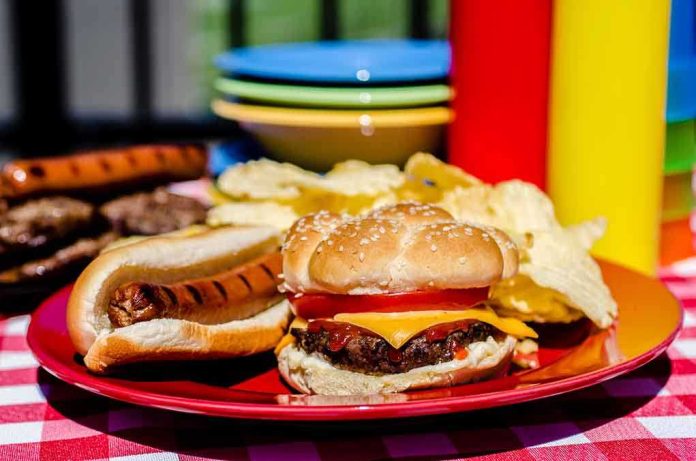
Los Angeles almost tried to fight wildfires by coming for your backyard carne asada, and the political firestorm burned hotter than any grill.
Story Snapshot
- LA mayoral hopeful Nithya Raman pushed a motion that opened the door to restricting backyard barbecues on high-risk “Red Flag” fire days.
- The measure morphed from bureaucratic wildfire planning into a culture-war brawl over whether City Hall can touch your grill tongs.
- Another councilmember stripped out the barbecue limits, warning that banning family cookouts is wildly out of touch with real life.
- The episode shows how climate anxiety plus technocratic politics can collide head-on with common sense, liberty, and tradition.
How A Wildfire Motion Turned Into A Backyard BBQ Panic
Los Angeles City Council member and mayoral candidate Nithya Raman co-authored a motion to “enhance red flag warning declarations,” the city’s term for those hot, dry, high-wind days when a spark can turn into a disaster.[1] The motion asked city departments to study tightening rules on ignition sources during those periods. That included looking at “emergency restrictions” on backyard barbecues, fire pits, and other open flames in residential neighborhoods, framed as part of proactive wildfire preparedness.[1] On paper, it sounded technical. In practice, it lit a political fuse.
Conservative outlets framed the idea plain and simple: a Los Angeles mayoral hopeful wants to ban your backyard barbecue to fight wildfires. For voters who see their grill as part of the American backyard birthright, “emergency restrictions” read like “here comes the nanny state.” The fact that the motion focused on temporary limits only on declared Red Flag days did not matter much in the public imagination. Once people heard “ban” and “barbecue,” the nuance was charcoal dust in the Santa Ana winds.
Red Flag Days, Real Risk, And Missing Evidence
City Hall does have a legitimate problem: Red Flag wind events in Los Angeles can turn the hills into tinder, with gusts forecasted up to 80 or even 100 miles per hour in some areas. Raman’s own office sends windstorm advisories telling residents to secure loose items and use extreme caution with anything that can spark. From a pure risk-management standpoint, clamping down on open flames during those windows sounds rational. The problem is that the public has not seen concrete data showing backyard grills are a meaningful driver of Los Angeles wildfires.[1]
The council motion talks generally about ignition sources and “proactive work” in high fire risk areas.[1] It does not present cause-of-fire statistics that single out residential barbecues as a key villain. Without those numbers, the measure feels to many like symbolic climate virtue more than targeted prevention. American conservative instincts kick in here: government should identify the actual culprits, document the problem, and then tailor restrictions narrowly. When public officials go straight for ordinary family behavior without making that evidentiary case, trust evaporates faster than lighter fluid on hot coals.
The Council Revolt And A Political Body-Slam
Backlash did not just come from talk radio. Councilmember Monica Rodriguez, who represents large swaths of the San Fernando Valley, moved to strip the barbecue language out of the motion entirely.[1] She pointed out that the last thing Angelenos need is a ban on hosting carne asada in their own backyard and argued the proposal was disconnected from how families actually live. That criticism hits a nerve: for working- and middle-class households, the backyard grill is one of the last affordable pleasures that does not require a permit, subscription, or ticket fee.
Los Angeles mayoral candidate Spencer Pratt trolls candidate Nithya Raman following a report that she proposed a backyard BBQ ban to stop wildfires.
Raman introduced a motion this week directing city officials to “examine emergency restrictions on grilling during Red Flag… pic.twitter.com/bV4DqVK3wW
— Collin Rugg (@CollinRugg) May 15, 2026
The timing could not have been worse for Raman. In a televised mayoral debate, opponents hammered her over wildfire policy, city priorities, and quality-of-life issues, turning the barbecue flap into a shorthand for technocratic overreach.[2] Conservative commentators described the proposal as “file it under D for dumb,” embodying a mentality that reaches first for control of private life rather than fixing chronic failures on crime, homelessness, or brush clearance. From a common-sense conservative lens, you harden power lines, manage vegetation, and prosecute arson; you do not start by micromanaging the family grill.
Culture War, Climate Policy, And The Backyard Line In The Sand
The barbecue battle fits a bigger pattern. Local governments, under pressure to “do something” about climate-related risks, reach for highly visible consumer-facing rules. Critics then recast those measures as attacks on everyday freedom rather than neutral safety policy.[1][2] When City Hall treats the backyard—one of the last semi-sovereign spaces Americans feel they still control—as a zone for experimental regulation, it triggers more than annoyance. It taps into a deeper suspicion that elites want behavioral compliance from citizens while leaving institutional failures untouched.
Wildfire reality is serious in Southern California, and adults can accept temporary sacrifices when leaders act with humility, transparency, and clear evidence. But the barbecue saga shows what happens when officials reach beyond what the facts justify and what common sense will bear. A smarter approach would focus on proven ignition sources, voluntary guidance, and education first, reserving narrow, clearly justified bans for situations where data shows real danger. Until then, Angelenos are likely to keep one eye on the hills—and the other on any politician who tries to take away their tongs.
Sources:
[1] Web – LA Council Advances Effort to Bolster Preparedness on Red Flag Days
[2] Web – LA Mayoral debate: Bass, Pratt, Raman clash over wildfire failures …