

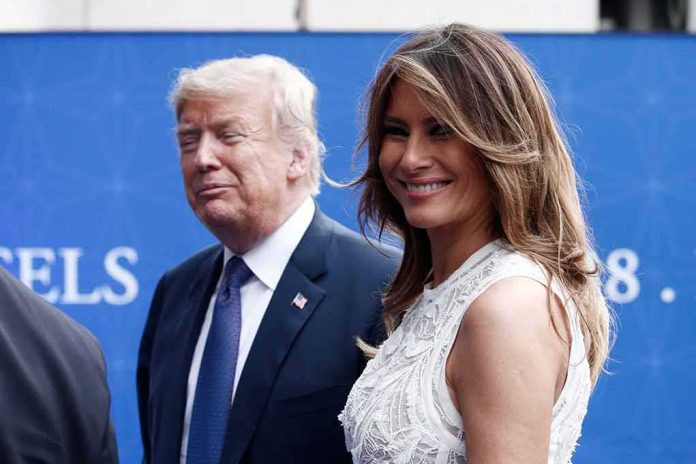
The White House says Melania Trump helped reunite nine more Ukrainian children with their families after talks linked to a short ceasefire in Oleshky.
Story Snapshot
- The White House reported nine additional child-family reunions tied to Melania Trump’s efforts.
- A six-day localized ceasefire in Oleshky enabled aid and evacuations, according to multiple outlets.
- Russian and Ukrainian officials cooperated for the reunions, the White House said.
- Human rights bodies say family reunification aligns with international law obligations.
What Happened: Nine Children Reunited After Oleshky Truce
The White House announced that nine more children were reunited with their families, crediting First Lady Melania Trump’s humanitarian push and cooperation by Russian and Ukrainian leaders. Officials tied these outcomes to channels opened during a short ceasefire in Oleshky, a city under Russian control. That truce paused fighting long enough to move aid and civilians. Reporters earlier described the Oleshky pause as limited, local, and time-bound, but real on the ground.
The administration’s November update framed the reunions as part of a continuing process rather than a one-time event. Associated Press coverage had detailed how the Oleshky stop in fighting allowed evacuations from a city short on food and medicine. Taken together, these reports describe a focused humanitarian track running alongside the wider war. The ceasefire did not end the conflict, but it created a narrow window to move people and supplies out of danger.
How The Ceasefire Worked And Who Took Part
The White House and international outlets reported that Russian and Ukrainian officials agreed to the Oleshky pause after the First Lady engaged both sides. The localized deal lasted six days and covered a defined area, which made it easier to monitor and harder to derail. That narrow scope is common in wartime relief efforts. It aims at urgent needs like food, medicine, and safe passage for civilians rather than broad political terms that take months to settle.
Reuters reporting matched this picture, noting that the ceasefire’s purpose was to enable aid deliveries and evacuations from a frontline town with severe shortages. These accounts align with the White House statement that later highlighted child reunifications built on cooperation between the warring sides. While the larger fight continued elsewhere, the Oleshky corridor showed how limited deals can still save lives and reconnect families in a war zone.
Why Family Reunification Matters Under International Law
United Nations investigators have warned that moving children across borders or into occupied areas without strict limits can violate international humanitarian law. They stress that children should not be separated from parents and that any evacuation must be temporary and meet clear safety reasons. European Union studies have also called for tracing and return mechanisms, since families often lose contact when children are displaced by fighting and occupation.
𝐌𝐄𝐋𝐀𝐍𝐈𝐀 𝐓𝐑𝐔𝐌𝐏'𝐒 𝐐𝐔𝐈𝐄𝐓 𝐃𝐈𝐏𝐋𝐎𝐌𝐀𝐂𝐘 𝐉𝐔𝐒𝐓 𝐅𝐑𝐄𝐄𝐃 𝐍𝐈𝐍𝐄 𝐌𝐎𝐑𝐄 𝐖𝐀𝐑-𝐒𝐄𝐏𝐀𝐑𝐀𝐓𝐄𝐃 𝐊𝐈𝐃𝐒
The White House announced Tuesday that First Lady 𝐌𝐞𝐥𝐚𝐧𝐢𝐚 𝐓𝐫𝐮𝐦𝐩 has secured the reunification of nine more children separated from… pic.twitter.com/gbgwqQGUDu
— M.A. Rothman (@MichaelARothman) November 25, 2026
These standards explain why structured reunions carry weight beyond the headlines. Documented returns to legal guardians fit with the duty to protect family unity in wartime. The White House says these nine reunions happened with both sides’ cooperation, which is key for safe transfers and record checks. That cooperation also reflects a basic truth of conflict: even narrow humanitarian deals can work when parties agree on specific steps, timelines, and outcomes that are easy to verify.
Sources:
whitehouse.gov, reuters.com, ohchr.org