

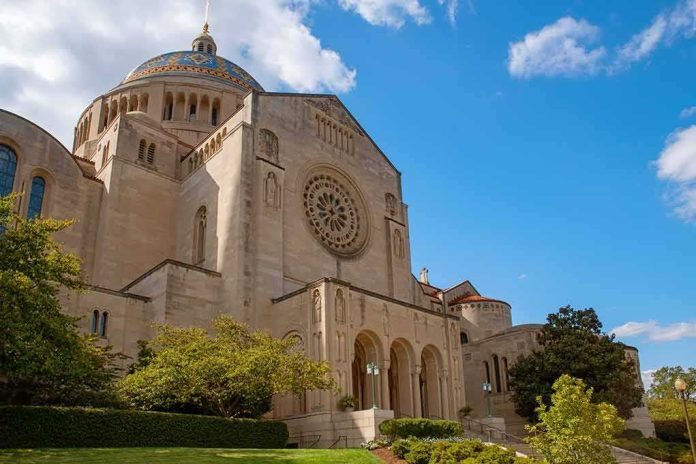
Police say a man stole a Saint Nicholas bone fragment from a French basilica and admitted destroying it, prompting church leaders to call it an attack on faith and history.
Story Highlights
- Parish leaders condemned the theft as an attack on believers’ history and devotion.
- Police identified a suspect on security video; reports say he confessed to burning and crushing the bone.
- The thief broke the glass case at the Basilica of Saint-Nicolas-de-Port to take the relic.
- The diocese held a Mass of reparation on November 20 after the reported destruction.
What Happened At The Basilica
French reports say the theft took place at the Basilica of Saint-Nicolas-de-Port in Lorraine, where a small bone fragment attributed to Saint Nicholas was on display. The parish said the act struck at the heart of local identity and the devotion of many pilgrims. Police reports described a break-in at the display. The suspect smashed the protective glass and removed the relic from its small case before leaving the church with it in hand.
Investigators reviewed security footage and said they identified a man linked to the scene. Subsequent reports state the man admitted taking the fragment and destroying it after the theft. Accounts say he burned the bone and crushed what remained. Authorities have not publicly named the suspect, and the relic has not been recovered based on available reporting. Church leaders condemned the act and described the loss as intentional harm against a revered object of Christian heritage.
How Church Leaders Responded
The Diocese of Nancy and Toul called the incident a desecration and organized a Mass of reparation at the basilica on November 20. That liturgy aimed to heal a wound the community felt after the reported destruction of the relic. Parish leaders issued a statement saying the act was not only about heritage but also an assault on centuries of faith and the devotion of pilgrims who come to venerate Saint Nicholas at the site.
Reports attribute a motive to the suspect that echoes the parish’s claim that the act was intentional. Several outlets say the man told police he viewed the relic as a “symbol of fetishism,” and that belief drove him to destroy it. The basilica remains a known center for Saint Nicholas devotion in France, and the event added urgency to local efforts to protect cultural and religious items on display to the public.
What We Know And What Is Still Unclear
Published accounts differ on the exact date of the theft, with timelines pointing to late October or early November. Outlets also note that police have not released the suspect’s name or court records that detail charges. One report explains the destroyed fragment was not the basilica’s principal Saint Nicholas relic, which is kept in a separate arm-shaped reliquary in the treasury. That context helps frame the scale of the loss while not minimizing the offense.
A man stole and destroyed one of the relics of St. Nicholas of Bari (or Myra), which are kept in the Basilica of Saint Nicolas-de-Port in the Lorraine region of France.
The alleged perpetrator, who was identified through security footage, stated that he stole a bone fragment of… pic.twitter.com/xq010DKabh
— EWTN News (@EWTNews) November 25, 2026
Relics can raise questions about authenticity and provenance. The reports identify the fragment as attributed to Saint Nicholas, but they do not cite lab testing for this piece. Even so, police accounts and church statements align on key facts: a man broke the case, removed the bone, and reportedly admitted to destroying it. For many believers, the meaning rests less on lab proof and more on the shared tradition attached to the basilica and its relics.
Why It Matters Beyond One Church
Attacks on sacred objects can shake trust in public institutions to guard heritage that communities value. When vandals target churches, synagogues, or mosques, they do more than damage property. They strike at identity, memory, and the ties that hold people together. That worry crosses party lines. People on the right and the left see officials struggle to protect basic civic goods, from safe streets to treasured sites. This case adds to that sense of drift and neglect.
Sources:
nypost.com, dnyuz.com, ibtimes.co.uk