

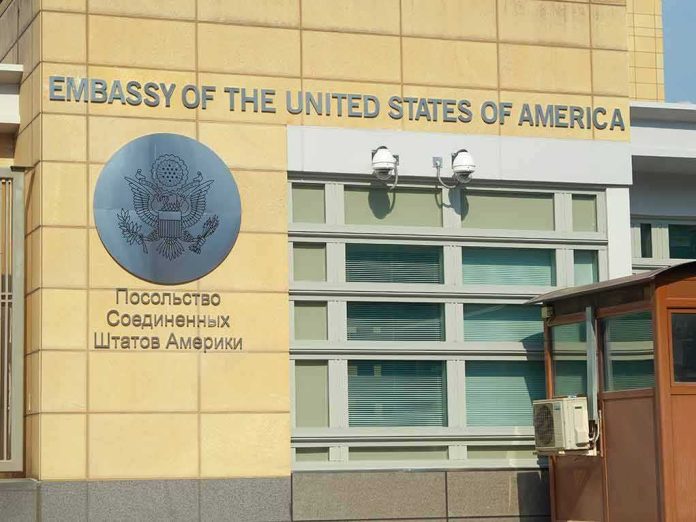
On October 31, the U.S. Embassy in Moscow warned of a “credible” mass-casualty threat at a specific Moscow landmark, and Russia moved to respond the same day.
Story Snapshot
- The U.S. named a date, site, and safety steps for a mass-casualty threat in Moscow.
- Russia’s Federal Security Service said it received U.S. information and took measures.
- Reports described closures and access limits at the named site amid police activity.
- Officials did not release the source, actors, or attack method, leaving key details unseen.
What Officials Said And Did, And Why It Matters
On October 31, the United States Embassy in Moscow told Americans to avoid the Tsaritsyno Museum Reserve that day, calling the threat “credible” and giving the exact address. The alert listed simple steps: avoid crowds, stay alert, charge phones, carry identification, and watch local news. The embassy also said the United States was coordinating with Russian authorities on a response. This was not a vague travel note; it was a targeted, time-bound warning.
Russia’s Federal Security Service said it had received information from the United States through partner channels about preparations for a terrorist attack in Moscow. The service said it was taking appropriate measures. Reuters reported that the museum complex was temporarily closed and that access to the park area was restricted. Police patrols increased. These steps show Russian authorities treated the tip as actionable, even as they did not publish their own evidence.
What We Still Do Not Know From Public Records
The public alert did not name a suspect, a group, or a method of attack. It did not share how the location or date were identified. There was no time window for the risk beyond that day. As of the reports cited, there was no public outcome stating whether an attack was attempted, disrupted, or never set in motion. One outlet cited a park message claiming normal operations, which conflicts with reports of closures and restrictions.
These limits are common in security warnings. Officials often reveal the “what” and “where,” but hold back the “how” and “who” to protect sources and methods. That choice can frustrate the public. People across the political spectrum worry about fear-based messaging, media hype, and elite gamesmanship. Yet withholding details can also reduce copycat risk and shield active investigations. The result is a gap that invites speculation and erodes trust over time.
How This Fits Recent Patterns And Why Trust Is Strained
United States officials have shared threat intelligence with Russia before. In March 2024, the embassy warned about extremists targeting large gatherings, including concerts. About two weeks later, a massacre at a Moscow concert hall killed more than 140 people. That history explains why some see the new October 31 warning as prudent. It also shows why early alerts may prevent harm but leave little proof when nothing visible happens.
Media and commentators linked the Moscow alert to other tense global signals, asking if governments are over-amping fear. That is a fair question when details stay classified. But the core facts here remain: the United States named a site and date, gave safety steps, and said it coordinated with Russia; Russia’s security service acknowledged receipt and action. Those points are documented. Disputes focus on interpretation, not whether the warning existed.
What To Watch Next: Evidence, Accountability, And Public Safety
Officials on both sides could reduce doubt by releasing a short, declassified summary. That could explain why the threat was judged credible, how the date and place were chosen, and whether actions at Tsaritsyno found anything concerning. Even a basic after-action note would help. Without that, people fill the void with their priors about information wars, political timing, and the sense that elites hide the ball when it suits them.
Russian security authorities have stepped up precautionary measures after the United States warned of a credible threat of a possible terrorist attack at a popular museum and park complex in Moscow.
The US Embassy in Moscow issued an alert on Saturday, 31 October 2026, warning… pic.twitter.com/VVUi4AfJnF
— Daily Tribune (@tribunephl) November 1, 2026
For now, two truths can stand together. First, a specific, same-day warning merits attention, and cooperation across bitter lines can save lives. Second, a government that asks citizens to trust its word owes them enough daylight to judge results. In an era of rising costs, widening gaps, and mounting distrust, facts matter most when leaders show their work. Clear records are not a favor to the public; they are the job.
Sources:
newsweek.com, themoscowtimes.com, rmb.reuters.com, fox5atlanta.com, ijr.com