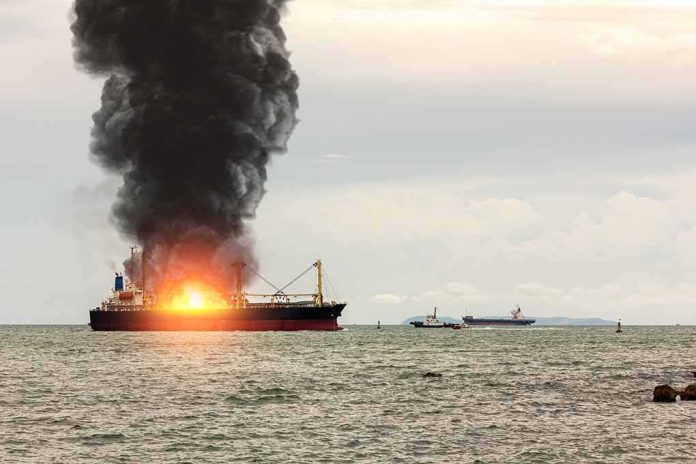
Ukraine’s quiet drone war at sea has now hit 196 Russian-linked vessels, raising big questions about who really controls the Black Sea—and how far leaders on all sides will go to protect their power and money.
Story Snapshot
- Ukraine’s Unmanned Systems Forces say they have struck 196 Russian “shadow fleet” vessels in the Black and Azov seas since July 6, using maritime drones.
- The strikes focus on tankers and cargo ships that move Russian oil, fuel, and stolen grain, aiming to choke Moscow’s war funding and supply lines to occupied Crimea.
- President Volodymyr Zelenskyy and key commanders claim Russia has “lost the Black Sea,” pointing to dozens of damaged or destroyed naval ships and support vessels.
- Independent outlets confirm the drone campaign and some ship losses but say the exact 196-vessel figure and level of damage are not fully verified.
Ukraine’s Drone Fleet Claims 196 Russian Vessels Hit
Major Robert “Madyar” Brovdi, the commander of Ukraine’s Unmanned Systems Forces, says his units have struck 196 Russian vessels between July 6 and July 22. He describes a rolling campaign called Operation MoLoChKa that uses explosive sea drones against Russia’s “shadow fleet” of tankers and cargo ships in the Black Sea and Sea of Azov. In a 48-hour window on July 21–22 alone, Brovdi reports hits on one tanker, ten dry cargo ships, and two tugboats. His message is simple: Russian-linked ships that help the war effort are no longer safe.
Ukrainian and allied outlets repeat the same number, showing this is now an official talking point, not just a rumor. The strikes follow earlier nights when Brovdi’s teams claimed to hit 28 vessels in the Sea of Azov, including 21 tankers and multiple tugboats and cargo ships. Other reports describe overnight attacks destroying or “eliminating” clusters of shadow fleet ships, sometimes more than a dozen in one operation. Put together, these events add up to a picture of steady, targeted pressure on Russia’s logistics at sea.
Targeting Russia’s Shadow Fleet and Crimea Lifeline
Ukraine says these drones are not just hitting random ships; they are going after the economic veins that keep Russia’s war machine alive. The so-called shadow fleet carries oil and other goods that help Moscow dodge Western sanctions and earn hard cash. Many of the targeted vessels also haul fuel, weapons, and grain taken from occupied Ukrainian land, moving through ports like Mariupol, Berdiansk, and routes near Crimea. By striking tankers, cargo ships, tugboats, and even ferries, Ukraine is trying to make it too risky and too costly for Russia and its partners to keep using these routes.
Major Brovdi and other officials say the goal is to “turn off” Russia’s shadow fleet and isolate occupied Crimea. A New York Times report quotes maritime analysts who see real disruption, including dozens of vessels hit in just a few days and cargo flows forced to change. Ukraine has also combined these ship strikes with attacks on power nodes and substations in Crimea and other occupied areas, under an effort labeled “Crimean Switch Off.” For everyday Ukrainians and Russians, this means more risk to energy lines, port jobs, and trade routes that once felt distant from front-line battle.
Zelenskyy’s Sea Strategy and Putin’s Vulnerable Flank
President Zelenskyy has used these successes to claim that Russia has “lost the Black Sea.” Ukrainian navy spokesmen say they have destroyed or disabled roughly a third of Russia’s Black Sea warships since the full invasion began. Open-source lists and Western outlets highlight multiple Russian landing ships, patrol boats, and even a submarine that have been sunk, scuttled, or badly damaged by missiles and drones. Business Insider and Newsweek note that, by public counts, about half of Russia’s Black Sea Fleet warships have been destroyed or forced out of normal combat use. For Vladimir Putin, who sells strength and control to his own people, those numbers are not just military losses but political embarrassments.
Ukraine’s success at sea also exposes how much modern war depends on private money, shipping lanes, and quiet deals with foreign partners. Russia’s shadow fleet relies on global insurers, shell companies, and ports outside Russia to move oil and goods despite sanctions. When drones start blowing holes in those tankers and cargo ships, the pain is felt not only in Moscow, but in boardrooms and ministries across Europe, the Middle East, and beyond. Many Americans who distrust their own “deep state” can see the pattern here: powerful networks try to shield their business, while regular people pay the price for war and rising energy costs.
What’s Proven, What’s Claimed, and Why It Matters for Voters
Some parts of Ukraine’s story are clearly confirmed, and others are still claims waiting for full proof. Major Brovdi’s 196-vessel figure comes from Ukrainian military statements and pro-Ukraine media, not from neutral inspectors counting wrecks. The wording often shifts between “hit,” “struck,” “impacted,” “destroyed,” and “eliminated,” and British reporting warns that some ships may have been targeted more than once. The New York Times says it could verify strikes on at least 11 vessels in one period but could not confirm Ukraine’s larger claim of over 100 damaged or destroyed ships in the Sea of Azov. That means the campaign is real, but the exact numbers and level of damage still need outside review.
Ukraine Sinks Rosatom Ship, Strikes Bashneft Refineries 994 Miles Inside Russia | Jackie Manning, Techtimes
SBU drones hit three Bashneft plants while USVs sank Rosatom’s Yanina in the Black Sea
In a single overnight operation, Ukraine's autonomous and long-range weapons… pic.twitter.com/gpLJ287dHK
— Owen Gregorian (@OwenGregorian) August 3, 2026
This is where many citizens on both the right and left grow uneasy. They see governments trading in big numbers and tough talk, while basic checks and full transparency lag behind. Conservatives who worry about endless wars, globalist oil games, and rising fuel prices can read these reports and wonder who is really winning from this sea war. Liberals who fear growing inequality and corporate power see another example of shadow fleets and sanction-dodging networks steering policy behind closed doors. In both cases, the sense is familiar: elites play by one set of rules, and everyone else lives with the fallout.
Sources:
youtube.com, united24media.com, nytimes.com, en.defence-ua.com, english.nv.ua, en.wikipedia.org, pbs.org, bbc.com, reuters.com, rferl.org, ua.news, newsweek.com, abcnews.com, facebook.com, kyivindependent.com, linkedin.com