
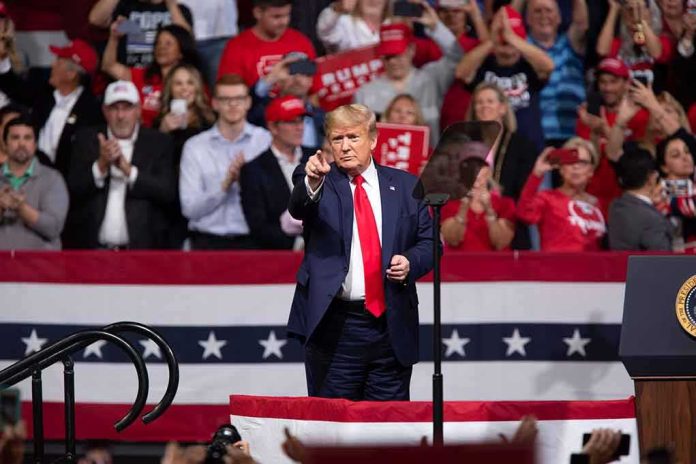
President Trump capped his San Antonio rally by dancing to “Y.M.C.A.” as the song blasted through a packed Freeman Coliseum.
Story Highlights
- Trump held an October 7 rally in San Antonio to boost Texas Republicans, including Ken Paxton.
- A pool report says “Y.M.C.A.” played as Trump ended his speech and he danced while departing.
- Local and national outlets documented protesters being escorted out during the event.
- The “Y.M.C.A.” walk-off is a recurring feature of Trump rallies and online clips.
Rally Setting and Purpose in San Antonio
President Trump spoke at Freeman Coliseum in San Antonio on October 7, 2026, as part of a push to aid Texas Republicans. Reuters reported that Trump addressed a packed arena and worked to bolster support for statewide candidates, including Senate hopeful and current Attorney General Ken Paxton. Local listings and coverage from San Antonio outlets also placed the event at the coliseum that evening, describing a turnout-focused rally keyed to midterm momentum and conservative enthusiasm heading into the final campaign stretch.
The rally fit a broader Republican plan to shore up a long-held stronghold. Republicans control Congress and the White House, but turnout still decides close races. Trump’s visit aimed to energize core voters in a state with fast growth, diverse suburbs, and sharp political debate. The message stressed party unity, border and crime concerns, and cost-of-living issues. Supporters saw the stop as a needed jolt for Paxton’s run, while critics viewed it as more culture war than policy.
The Closing Moment: “Y.M.C.A.” and the Trump Dance
A contemporaneous press pool report said Trump finished speaking at 7:52 p.m., and the arena sound system immediately blasted “Y.M.C.A.” The pool noted leaving the building while Trump danced near the exit path, marking a familiar closing routine for his rallies. A lifestyle outlet framed the moment as his “signature” move at the end of the San Antonio event, echoing a pattern seen at prior campaign stops where the same song and fist-pumping steps mark his walk-off.
This ritual has become part of Trump’s brand at rallies, a signal to the crowd that the formal program is over and the celebration has begun. Years of clips and local coverage have turned the dance into shorthand for his style: short, repeatable moves set to a pop anthem that supporters cheer and opponents mock. Media outlets documented similar scenes in earlier cycles, including national explainers on how “Y.M.C.A.” became his unofficial soundtrack.
Protesters and Crowd Management Inside the Arena
Reuters reported that several protesters interrupted the event inside the coliseum, and local coverage showed law enforcement escorting people out as the crowd responded with chants. That mix of loud support and visible dissent matched many high-profile rallies in recent years. Security and venue staff managed removals as the program continued. The interruptions underscored the size and intensity of modern rallies, where stagecraft, music cues, and fast crowd responses blend into a single, viral-ready scene.
Trump traveled to San Antonio for Paxton's “Midterm Rally,” repeatedly referred to Talarico as “Talafreako” and suggested he had disappeared. https://t.co/bKhe8ZscCu
— USA TODAY (@USATODAY) October 8, 2026
For many Americans, that mash-up of spectacle and politics evokes broader worries. People on the right and left say leaders focus more on image than results. The dance, the song, and the chants become symbols that race across social media, while families face high costs, weak public services, and deep mistrust in institutions. The San Antonio rally captured that tension: a polished finale, a charged crowd, and a country still waiting for steady progress on everyday problems.
Why This Moment Resonates Beyond One Rally
Trump’s “Y.M.C.A.” ending works because it is simple, familiar, and easy to share. Fans read it as energy and confidence. Critics see a show that masks hard issues. Either way, it travels. National and local outlets have chronicled the song-and-dance as a recurring feature that closes the loop between stage and screen, turning a real-world event into a quick clip that shapes the public memory of the night.
Voters also know the stakes behind the show. Republicans aim to expand control in Washington and Austin. Democrats aim to slow or block that agenda. Many independents and disaffected voters, though, worry that both parties play to the cameras while living costs rise, border policy whipsaws, and services disappoint. The San Antonio rally’s final scene, set to “Y.M.C.A.,” was one more example of how American politics now ends many nights: with music, motion, and debate over what it all means.
Sources:
facebook.com, soapcentral.com, pool.pp.tools, time.com, oann.com, ksat.com, c-span.org, fox4news.com