

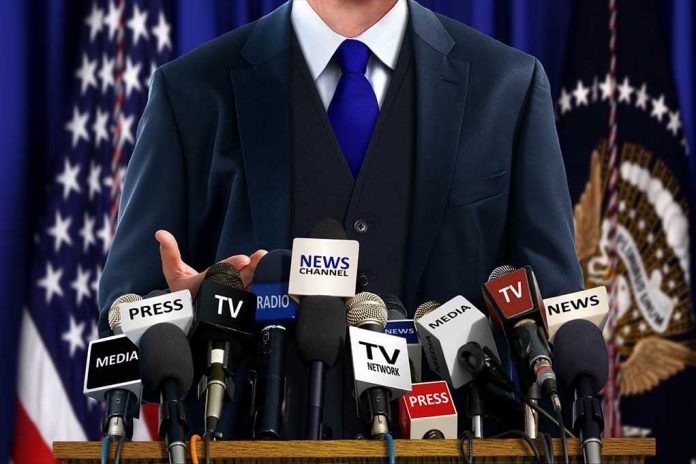
President Trump announced an “effective immediately” ban on CNN, MS NOW, and Politico from the White House, citing “fake news.”
Story Snapshot
- Trump named CNN, MS NOW, and Politico and said the ban starts “effective immediately.”
- He tied the move to “fake news” and “purposely negative stories,” not specific errors.
- Press-freedom groups and outlets called the move unconstitutional and vowed to fight it.
- Reports said it was unclear how, or whether, the White House enforced the ban that day.
What Trump Announced And Why It Matters
President Trump said he is banning CNN, MS NOW, and Politico from the White House “effective immediately,” accusing them of spreading “fake news.” Multiple outlets reported the announcement on September 18, 2026, naming the three organizations and noting Trump warned others could follow. The President framed the reason as biased coverage and “purposely negative stories,” not a list of proven false reports. The statement set off a fast legal and political debate over government limits on press access.
Trump also pointed to Politico as allegedly taking an $8 million “subscription” from the federal government under the prior administration, calling it corrupt. Reports carried the charge but did not include documents proving illegality or contract details. Without primary records, the corruption claim remains an accusation, not an established fact. That lack of documentation leaves readers with a charge but not the evidence needed to judge it on the merits.
How Newsrooms And Watchdogs Responded
CNN called the ban an “illegal assault” on press freedom protected by the First Amendment to the Constitution. Politico said it will keep reporting on the White House and will defend its rights in court if needed. Free speech experts quoted by Reuters said the move likely conflicts with the Constitution and would face legal challenges. The White House Correspondents’ Association said press freedoms do not hinge on whether a president likes an outlet’s coverage.
Freedom of the Press Foundation leaders said banning outlets over their coverage is a clear First Amendment violation. The response from these groups highlights a shared fear across the spectrum: government power used to reward friendly speech and punish critical speech. That fear cuts beyond party labels. Many Americans worry that leaders in both parties protect insiders first and treat watchdogs as enemies. This episode will likely deepen that concern unless rules and reasons are made public.
What Is Known About Enforcement So Far
Some reports said it was not clear whether the White House took formal steps to enforce the ban, like revoking credentials or changing entry lists, immediately after the announcement. Coverage also noted that Trump’s definition of “fake news” focused on negative tone rather than provable falsehoods. The gap between a sweeping claim and concrete examples raises practical questions. It also shapes any court test, where viewpoint-based rules face tougher scrutiny than neutral security rules.
Legal fights over press access have flared before. Courts have held that when the government opens spaces to journalists, it cannot exclude some because of their viewpoint. Past disputes, including over individual reporters and outlets, show that access rules must be clear, consistent, and tied to real needs, not dislike of coverage. If the administration issues written criteria and applies them evenly, it may reduce conflict; if not, lawsuits and injunctions are likely.
Why This Hits A Nerve For Both Left And Right
Americans across the political map see a pattern: powerful people bend rules to suit their allies and silence critics. Conservatives see years of media hostility and double standards. Liberals see government pressure on independent news and rising inequality. Both see elites protecting themselves. A public ban, launched by social post and lacking clear policy paperwork, fuels the belief that process is for show. Transparent rules and records would help restore trust, or set the stage for court review.
Sources:
english.news.cn, salon.com, indiatoday.in, uk.news.yahoo.com, globalnation.inquirer.net