
President Trump’s China trip is turning AI—and the microchips that power it—into the newest battleground where U.S. security, corporate influence, and everyday jobs collide.
Quick Take
- Trump departed May 13 for a three-day Beijing visit with AI and chip policy at the center of talks with Xi Jinping.
- Nvidia CEO Jensen Huang joined the delegation at the last minute after Trump reportedly called him directly, highlighting the industry’s influence.
- China has floated an AI “no-blame hotline” and formal dialogue framework, but U.S. officials signaled low expectations for concrete commitments.
- In Cannes, film leaders proposed mandatory AI labeling while Meta’s sponsorship and on-site tech presence fueled fresh backlash about privacy and creative control.
Trump Brings Tech Power to Beijing as AI Stakes Rise
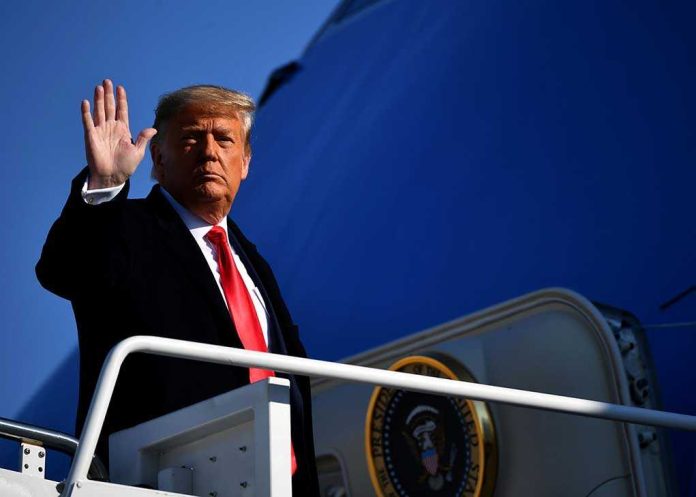
President Donald Trump left for Beijing on May 13 ahead of scheduled meetings with Chinese leader Xi Jinping on May 14–15, with artificial intelligence positioned as a central topic alongside trade and security issues. The White House delegation includes more than a dozen business and technology leaders, reflecting a strategy that treats private-sector capability as a national asset. Trump also signaled a market-access push, urging China to “open up” so U.S. innovators can compete.
One detail drew outsized attention: Nvidia CEO Jensen Huang was not on an early delegation list but joined after Trump reportedly called him following media coverage of his absence. Nvidia confirmed Huang’s participation and said he would support U.S. goals. The episode matters because advanced chips remain America’s strongest leverage in the AI race, and corporate priorities—sales, supply chains, investor pressure—do not always align neatly with long-term national security planning.
Semiconductor Controls Remain the Leverage Point—and the Flashpoint
U.S. restrictions on exporting advanced semiconductors to China have been in place since 2022, and Nvidia’s H200 AI chips remain subject to limits despite the existence of government-approved variants. At the same time, the research indicates internal policy crosscurrents: lawmakers are pressing tougher measures like the proposed MATCH Act, while the administration has shown openness to easing some export curbs. That split creates uncertainty for industry and raises the stakes of any summit messaging.
China, for its part, is pushing to reduce the risk of AI-driven miscalculation while still pursuing technological self-sufficiency. Chinese officials have proposed a formal AI dialogue mechanism led by Treasury Secretary Scott Bessent and Vice Finance Minister Liao Min, plus a “no-blame hotline” concept for incidents involving advanced systems. U.S. officials acknowledged AI is central to the talks, but they also indicated expectations are modest—suggesting discussions may be more about guardrails and process than binding agreements.
Mythos Model Shockwaves Put AI Safety on the Diplomatic Agenda
The immediate urgency around AI governance has been amplified by Anthropic’s release of its Mythos model, which reportedly exposed thousands of software vulnerabilities. That kind of capability has two political consequences at once: it strengthens the argument for tougher safety vetting of frontier models, and it intensifies the fear that powerful tools could be weaponized by hostile states or criminals. For Americans already skeptical of elite competence, it also spotlights how fast AI risk is outpacing government readiness.
Cannes Highlights a Cultural Backlash as Meta Expands Its Footprint
While Trump’s delegation landed in the world of statecraft, the Cannes Film Festival opened the same day amid escalating fights over AI’s role in culture and work. Festival director Thierry Fremaux announced mandatory AI labeling requirements for films, signaling pressure for transparency in creative production. High-profile voices expressed sharper resistance, including director Guillermo del Toro’s blunt public condemnation of AI use in art—an argument rooted in authorship, employment, and artistic control.
Meta’s presence at Cannes underscored another tension: large tech companies are not only building AI tools, they are buying legitimacy and influence in cultural institutions. The research describes Meta’s multi-year sponsorship, operations based out of the Majestic Hotel, and on-site deployment of Ray-Ban glasses described as capable of instant facial identification. Even without broader regulatory conclusions, the juxtaposition is politically combustible—public trust erodes when people see powerful platforms shaping norms in both entertainment and surveillance-adjacent tech.
Sources:
Trump-Xi summit puts AI rivalry in spotlight amid Mythos model shockwaves (2026-05-13)
Hollywood ghosts Cannes and Trump
Donald Trump to meet Xi Jinping in China for high-stakes three-day visit
Trump called Nvidia’s Jensen Huang to join China summit at last minute – report