Iran has moved from threatening shipping lanes to actively controlling two of the world’s most critical sea gates, and that shift now exposes just how limited Washington’s options really are.
Story Snapshot
- Iran has effectively become the gatekeeper of the Strait of Hormuz, throttling global energy flows and charging tolls.
- Tehran is signaling it can extend this leverage into the Red Sea by working through Houthi forces near Bab el-Mandeb.
- President Trump faces a hard choice: escalate militarily, cut a deal, or accept a long-term hit to U.S. power and the world economy.
- The crisis highlights a deeper problem many Americans see: elites play power games while ordinary people pay higher costs.
Iran’s New Grip on the Strait of Hormuz
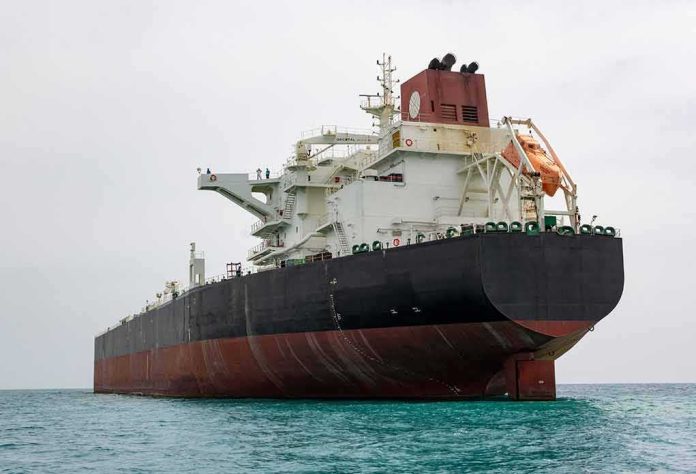
Since early spring, Iranian forces have used mines, drones, and armed boats to halt most shipping through the Strait of Hormuz, the narrow waterway that once carried about 20 percent of the world’s oil and gas. Reports from international monitors say traffic at one point fell by more than 90 percent as tankers either stayed away or sought direct permission from Iran to pass. This is not just harassment. Analysts now describe Iran as the effective “gatekeeper” of Hormuz, deciding which ships move and under what conditions.
Iran is turning that control into money and political leverage. Multiple reports say Tehran has begun charging tolls of up to $2 million per ship for “safe passage,” with some vessels already complying. Iran has floated plans to share part of this revenue with Oman to rebuild war-damaged infrastructure, tying local allies into its new system. Experts estimate these fees could bring Iran well over $1 billion a month in combined oil and gas transit charges, even while global markets struggle with higher prices.
From One Chokepoint to a Network of Pressure
Strategists warn that Iran is no longer focused only on Hormuz. A detailed Reuters report says that after choking off shipping in the Gulf, Tehran is now signaling it could use its Houthi allies in Yemen to threaten or even close the Bab el-Mandeb strait, the gateway from the Red Sea to the Indian Ocean. That narrow channel links the Suez Canal to Asian trade routes. If traffic there is blocked, tankers and container ships would face long detours around Africa, driving up costs and delivery times worldwide.
Security analysts describe this as “chokepoint warfare” or “connectivity coercion.” Iran cannot match U.S. naval power ship for ship, but it can control key bottlenecks that the global economy depends on. By pairing Hormuz with Bab el-Mandeb through local proxies, Iran builds a network of pressure points that reach far beyond the battlefield. Studies of recent conflicts find that when fighting happens near these bottlenecks, the economic shock spreads quickly across regions and even into great-power rivalries, including U.S.–China competition.
Trump’s Dilemma and Limits of U.S. Military Power
President Donald Trump responded to Iran’s moves by ordering a naval blockade on Iranian ports and promising to reopen Hormuz to “free” shipping. U.S. forces have carried out strikes on Iranian speedboats, coastal sites, and drones, and tried to escort tankers through alternate routes in Omani waters. Yet months into the crisis, independent analyses say the U.S. Navy has not been able to fully clear mines or restore normal traffic, and its readiness in other regions has suffered.
Reports from Washington describe talks where Iran uses control of Hormuz as a bargaining chip on nuclear policy, sanctions relief, and even formal recognition of its right to set rules for passage. One Council on Foreign Relations analysis bluntly states that Trump’s blockade “has a short fuse,” because it relies on global cooperation that weakens as oil prices rise and allies feel their own economies squeezed. The more this standoff drags on, the more it looks like a test of political endurance, not just military strength.
Ordinary Americans Feel the Cost of Elite Power Games
Iran’s control over Hormuz has already pushed up prices for gasoline, fertilizers, and many basic goods, adding pressure to families who were already dealing with inflation and high energy costs. Farmers pay more for fuel and fertilizer. Truckers pay more to move goods. Consumers see higher prices at the pump and the grocery store. None of these people had a say in the war plans in Tehran or Washington, yet they pay when trade routes are turned into weapons.
It appears that the Houthis in Yemen have been tasked with transforming Bab al-Mandab into an operational alternative to the Strait of Hormuz, given Iran's declining ability to use the latter as leverage due to American military strikes. With the Houthis already rushing to…
— خليل العمري Khalil Muthanna (@KhalilAlomary90) July 23, 2026
For many Americans, this crisis confirms a fear they already had: powerful states and wealthy elites treat the global economy like a chessboard, while workers and small businesses end up as pawns. Iran’s leaders are using chokepoints to gain leverage and money. U.S. leaders are using blockades and sanctions to push back. Both sides talk about strategy and deterrence, but very few in government focus on shielding ordinary citizens from the fallout. That sense of a distant, self-interested “deep state” grows every time a foreign crisis spikes prices at home.
What Comes Next: Risk of a Wider Maritime Standoff
Experts warn that if Iran follows through on hints of using Houthi forces to disrupt Bab el-Mandeb, the world could face twin crises in Hormuz and the Red Sea at the same time. That would threaten energy flows from the Gulf, container traffic through the Suez Canal, and trade routes that link Europe, Asia, and Africa. It would also pull regional players, like Gulf monarchies and Israel, deeper into a confrontation that already feels less about borders and more about control of global circulation.
Security studies call this emerging pattern a “war of connectivity,” where the main contest is over who controls flows of oil, goods, and data rather than just land. Iran has shown that a mid‑sized regional power can punch above its weight by holding the world’s lifelines in its hands. For President Trump, the question is whether the United States can adapt to this new type of pressure without doubling down on wars and blockades that many Americans already believe cost too much, deliver too little, and leave the average citizen more exposed than protected.
Sources:
dw.com, globalpi.org, niacouncil.org, cnn.com, reuters.com, besacenter.org, almendron.com, crescent.icit-digital.org, jpost.com, cfr.org, en.wikipedia.org, theconversation.com, understandingwar.org, moderndiplomacy.eu, armyupress.army.mil, timesofindia.indiatimes.com, ardatunca.net, brookings.edu, strategicperspectives.cissajk.org.pk, ionanalytics.com, inss.org.il