

A president appears ready to turn his own $10 billion lawsuit against the government into a secretive $1.7 billion taxpayer-funded payout machine for political allies, and both the left and the right see the same warning sign: the system protects insiders, not you.
Story Snapshot
- President Trump is expected to drop his $10 billion lawsuit against the Internal Revenue Service in exchange for a $1.7 billion “weaponization” compensation fund. [1][3]
- The proposed Truth and Justice Commission would control taxpayer money with broad discretion and minimal transparency over who gets paid. [1][3]
- Critics warn that Trump-aligned figures, including some January 6 defendants and even Trump-linked entities, could benefit indirectly. [1][2][3]
- Legal experts question whether the deal abuses executive power and turns the Treasury’s Judgment Fund into a political slush fund. [2][4]
How Trump’s IRS Lawsuit Turned Into a $1.7 Billion “Weaponization” Fund
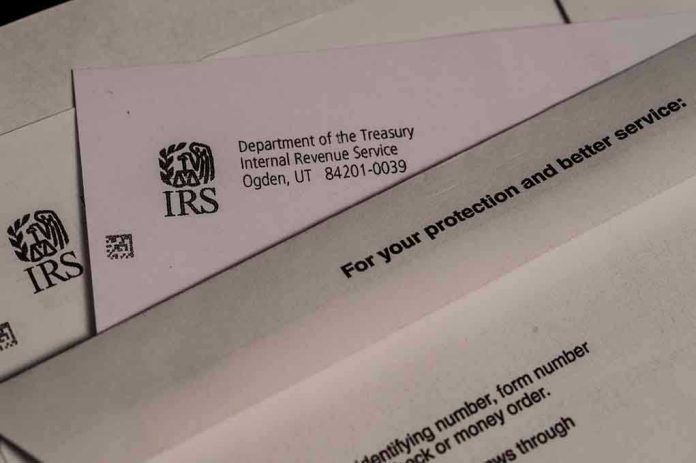
President Donald Trump sued the Internal Revenue Service for $10 billion earlier this year, accusing the agency of failing to prevent the leak of his tax returns to news outlets in 2019 and 2020, after a government contractor improperly accessed the data and later pleaded guilty in 2023. [1] According to reporting based on Justice Department and White House sources, Trump is now poised to drop that lawsuit in exchange for a massive settlement that does not pay him directly, but creates a new taxpayer-funded compensation mechanism. [1][3]
ABC News and other outlets report that the Justice Department is finalizing a deal creating what will be branded the Donald J. Trump Truth and Justice Commission, capitalized with about $1.7 billion taken from the Treasury Department’s existing Judgment Fund. [1][3] That fund normally covers court judgments and settlements against the federal government. In this case, it would bankroll payments to individuals who claim they were harmed by what Trump and his allies call the Biden administration’s “weaponization” of law enforcement. [1][3]
Who Could Get Paid, and Who Decides
Sources say the commission would be able to award compensation to a wide universe of claimants, including nearly 1,600 people charged in connection with the January 6 Capitol attack, as well as other Trump allies who say they were targeted for political reasons. [1][3] ABC News reports that while the settlement would bar Trump personally from receiving payments for his own legal claims, it would not clearly block entities associated with him from filing claims with the commission. [1][3] That structure alarms both ethics advocates and institutional watchdogs. [2]
Reporting indicates the commission would operate with minimal transparency. ABC News says it would have “total authority” to distribute roughly $1.7 billion in taxpayer funds and would not be required to disclose how it decides who gets compensated. [1][3] The New Republic and other commentators describe this as effectively giving Trump quasi-direct control over a large pool of federal money, because he could remove commission members without cause if they do not award funds as he prefers. [2] That combination of power, secrecy, and political loyalty fuels concerns about an elite payoff system.
Legal Red Flags: Executive Power, Appropriations, and a Judge’s Skepticism
Legal critics argue the proposed settlement strains basic constitutional and ethical boundaries. Public Citizen warned that any such deal raises “significant constitutional, legal, and ethical issues,” emphasizing that Internal Revenue Service officials must report political interference to agency watchdogs. Commentators note that Trump controls the Justice Department that is supposed to defend the government against his lawsuit, which means his administration is negotiating with itself over whether to direct public money toward people aligned with his political grievances. [2][4] That dynamic deepens public fears that both parties in Washington use government as a private tool.
⚡️JUST IN: Trump, his sons, and the Trump family business have settled their $10 BILLION lawsuit against the IRS, per Politico.
The case accused the agency of failing to properly oversee a contractor who leaked the president’s tax returns. pic.twitter.com/stnqGVoK3G
— crypto fact (@KrishnaYad49864) May 18, 2026
Judges have already signaled unease about Trump’s litigation. Lawfare reports that a federal judge in New York, Victor Marrero, dismissed an earlier Trump tax-return lawsuit, underscoring skepticism about his efforts to use courts around his financial information. [4] Another judge, described in media coverage as Kathleen Williams, reportedly questioned whether the current case presents a real “case or controversy” or instead resembles a “scam to enrich Trump,” and demanded briefing justifying why it should proceed. [3] That judicial skepticism reinforces the perception that this settlement is less about justice than about insider bargaining.
Why Both Left and Right See a Deeper System Failure
For many conservatives, the underlying leak reinforces a long-running belief that liberal bureaucrats inside the Internal Revenue Service, Justice Department, and other agencies selectively weaponize their power against political enemies, violating privacy and due process with little accountability. [1] For many liberals, the proposed commission looks like the opposite problem: a president using his control of federal machinery and Treasury funds to protect his own allies, including individuals linked to an attack on Congress, while ordinary Americans struggle with inflation, healthcare costs, and stagnant wages. [2]
Both reactions point to the same core worry: a federal government that bends rules for the powerful while leaving regular citizens to fend for themselves. The reported terms show insiders designing a bespoke process, potentially shielded from transparency rules, that could funnel huge sums to politically connected claimants without clear, publicly debated authorization from Congress. [1][2][3] Whether one focuses on the original tax-return leak or on the settlement itself, the pattern suggests a system where elites break things, then negotiate among themselves about who gets paid—with taxpayers footing the bill.
Sources:
[1] YouTube – Sources: DOJ finalizing deal for Trump to drop lawsuit against IRS
[2] Web – Trump’s Stupid IRS Lawsuit Will Be Settled with Our Tax Dollars
[4] Web – Federal District Court Dismisses Trump Lawsuit Over Tax Returns …