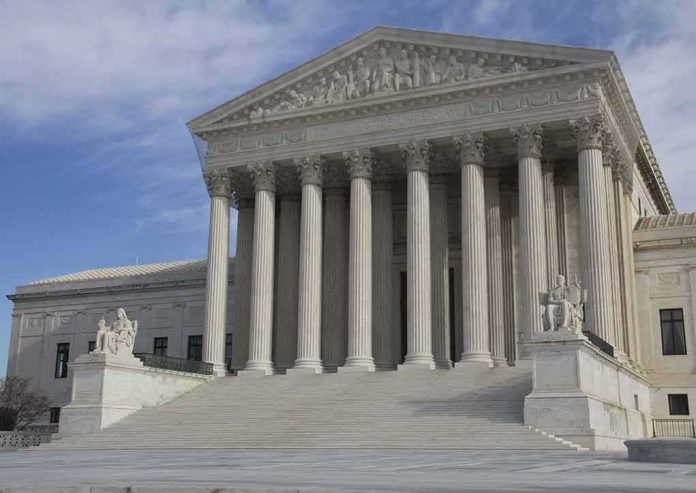
The Supreme Court has struck down President Trump’s attempt to narrow birthright citizenship, exposing just how far both parties will push the system before the Constitution finally pushes back.
Story Snapshot
- The Court rejected Trump’s order that would deny citizenship to many babies born in the U.S.
- Justices said the Fourteenth Amendment’s promise of citizenship at birth is clear and long-settled.
- The ruling highlights growing concern that presidents and Congress ignore constitutional limits.
- Both conservatives and liberals see the fight as proof a distant elite plays games with ordinary lives.
What Trump’s Executive Order Tried To Do
On January 20, 2025, President Trump signed Executive Order 14160, called “Protecting the Meaning and Value of American Citizenship.” The order said certain babies born in the United States would no longer be citizens at birth if their parents were here unlawfully or only on short-term visas and neither parent was a citizen or permanent resident. Federal departments were told not to issue or accept documents proving citizenship for these children, starting 30 days after the order. In plain terms, it tried to redraw who counts as American the moment a child is born.
The Trump administration’s lawyers argued that the Fourteenth Amendment phrase “subject to the jurisdiction” does not cover children of undocumented immigrants or short-term visitors. They claimed these parents lack “political allegiance” and lawful home ties in the United States, so their U.S.-born children are not true citizens. This theory leaned on older cases about allegiance, like Elk v. Wilkins, and tried to revive long-rejected ideas about limiting who belongs. For supporters, this looked like a firm stand on immigration; for critics, it looked like changing the rules for people at the bottom while the powerful stay protected.
How The Supreme Court Rejected The Plan
Multiple lower courts quickly blocked the order, finding it violated over a century of Supreme Court precedent and the clear text of the Fourteenth Amendment. A federal appeals court in Massachusetts upheld a block, calling the order a “flagrant violation” of the Constitution. Civil rights groups brought a nationwide class action, Trump v. Barbara, on behalf of children who would have lost citizenship, arguing the order defied both the Constitution and federal law. During arguments, justices pressed the government on why settled law should suddenly change, given that birthright citizenship has been part of American life for generations.
In its final decision, the Supreme Court ruled 6–3 against Trump’s attempt to limit birthright citizenship. The majority, led by Chief Justice Roberts, said the Fourteenth Amendment’s wording is “unequivocal” and that nearly everyone born on U.S. soil is a citizen. The Court reaffirmed the 1898 case United States v. Wong Kim Ark, which held that children born in the United States are citizens even when their parents are not. Five justices concluded the order clashed with this settled reading and could not stand under the Constitution’s Citizenship Clause. The order never went into effect; for families caught in the middle, the Court’s ruling stopped their newborns from becoming legal outsiders overnight.
The Split Inside A Conservative Court
The ruling was not unanimous, and the fractures matter in today’s tense politics. Three conservative justices—Clarence Thomas, Samuel Alito, and Neil Gorsuch—dissented, saying the Fourteenth Amendment allows the president’s narrow view of “jurisdiction.” Justice Brett Kavanaugh agreed the executive order broke federal law but argued it did not violate the Constitution itself, suggesting Congress could pass a statute to change birthright rules. That means even with a conservative majority and three Trump appointees on the bench, only three justices backed Trump’s approach outright, a sign his theory has limited support even on the right.
The Supreme Court just blocked Trump's order to end birthright citizenship in a 6-3 ruling, calling it unlawful under the 14th Amendment. His third major SCOTUS loss in months.#SupremeCourt #Trump #BirthrightCitizenship #14thAmendment #USPolitics pic.twitter.com/DTThZ08sJg
— LibertyUSA (@ADireitaVerdade) July 1, 2026
For many Americans, this split deepens a feeling that the system is driven by power games, not clear principles. Conservatives frustrated with illegal immigration see a Court blocking a president who promised to “fight for the people” at the border. Liberals angry over America First policies see that same president trying to strip babies of citizenship, then almost gaining support from part of the Court. Both sides see elites arguing over phrases like “political jurisdiction” while working families worry their kids’ basic status could change with one signature. The case feeds a shared fear: the rules of belonging can be rewritten from the top without the public’s voice.
What This Means For Ordinary Americans Now
Legally, the decision keeps birthright citizenship intact: if a baby is born in the United States, that child is a citizen, regardless of the parents’ status. Politically, the fight is far from over. Trump has already urged Congress to step in, and Justice Kavanaugh’s opinion gives lawmakers a road map for trying. Any new law would spark more lawsuits and more years of uncertainty for families, hospitals, and schools trying to handle everyday life. For citizens on both the left and right, the message is troubling: instead of fixing inflation, health costs, or wages, leaders are locked in battles over who counts as American at all.
The case also shows how much pressure the Fourteenth Amendment now carries. It was written after the Civil War to guarantee citizenship for formerly enslaved people and their children. Today, it is the last line of defense for many immigrant families as presidents test how far they can go without Congress. When courts, presidents, and lawmakers keep stretching these limits, people across the spectrum see confirmation of a deeper worry—that a distant “deep state” and political class treat the Constitution as a tool, not a promise. This ruling protects birthright citizenship for now, but it also warns that the struggle over who belongs in America is nowhere near finished.
Sources:
reason.com, en.wikipedia.org, supremecourt.gov, bbc.com, naacpldf.org, americanimmigrationcouncil.org, whitehouse.gov, oyez.org, asianlawcaucus.org, brennancenter.org