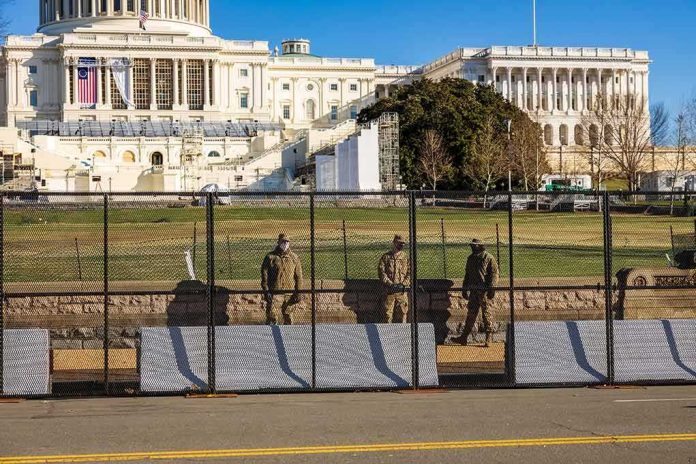
As thunderstorms rolled toward the National Mall on America’s 250th birthday, Washington’s biggest celebration was abruptly turned into a two-hour test of emergency planning and public trust.
Story Snapshot
- Severe storms forced a full evacuation of the National Mall during the Freedom 250 “Salute to America” event.
- Security checkpoints shut down, and tens of thousands were pushed into nearby federal buildings for shelter.
- Confusion over “extreme heat” versus storm danger added to public doubts about the government’s handling of the crisis.
- The episode shows how weather, safety, and politics now mix in ways that fuel frustration with federal leaders on both sides.
What Actually Happened on the National Mall
Freedom 250 organizers, working with federal security agencies, ordered an immediate evacuation of the National Mall at about 7 p.m. as severe thunderstorms approached. The official statement cited lightning, hail, heavy rain, and possible flash flooding as the reasons, and told everyone on the grounds to leave and seek shelter indoors. The United States Secret Service then shut down all screening checkpoints, stopping anyone else from entering the event area until the storms passed.
Local reports and videos show strong winds, very heavy rain, and frequent lightning strikes across the Washington, D.C., region as the storm line moved in. National news coverage described a “roughly two-hour evacuation” of the Mall, with July Fourth events up and down the East Coast disrupted by the same system. Organizers also canceled remaining military flyovers and delayed President Trump’s speech and the fireworks show until the weather cleared later that night.
How Evacuation and Shelter Orders Played Out
Once the evacuation began, attendees were told to head for specific federal buildings and museums around the Mall, including the Ronald Reagan Building, the Department of Commerce, the Department of Education, the Department of Agriculture, and several Smithsonian museums. Homeland Security and emergency managers circulated a detailed shelter list, and law enforcement officers directed crowds to move quickly but calmly and to avoid taking cover under trees. This kind of large-scale movement in a tight space is exactly what past D.C. evacuation studies have tried to plan for.
Crowd pressure quickly exposed weak points in that plan. The Internal Revenue Service building reached capacity and had to be taken off the shelter list, forcing thousands of people to shift to other sites in real time. News video shows long lines and packed lobbies as people tried to escape the storm but still stay close enough to return once the event resumed. Some social media clips capture frustrated attendees arguing with officers and choosing to wait out the weather on the Mall, which raised safety concerns but also showed how much distrust many citizens now feel toward official orders.
Storms, Extreme Heat, and Confusing Messages
Most official and local reports agree on one core fact: the trigger for the evacuation was severe thunderstorms and lightning, not heat alone. Freedom 250’s statement focuses on storm hazards like hail and flash flooding, and television coverage talks about “severe weather” and “thunderstorms” hitting the capital. At the same time, at least one major outlet framed the evacuation as driven by “severe storms and triple-digit heat,” tying the decision to both dangerous lightning and the intense temperatures that had baked crowds all day.
That split in wording matters because it feeds a larger pattern. People across the political spectrum already suspect leaders use “safety” as a vague excuse when things go wrong. Some conservative viewers see this as another sign that government managers cannot run big events without chaos. Some liberal viewers worry that authorities downplay heat risks, even as climate change makes extreme weather more common and more dangerous. In this case, no public medical reports have tied the evacuation to heat-related injuries, and no detailed federal safety audit has been released, which keeps those doubts alive.
What This Says About Trust, Safety, and Power
For many Americans watching or standing in that storm, the evacuation felt like more than just a weather delay. This was a once-in-250-years celebration, backed by the federal government, in a city that has planned for mass evacuations from terror attacks and dirty bombs. Yet a single line of thunderstorms was enough to shut down the heart of the event for two hours and cram citizens into government buildings, including tax offices, under the watch of armed agents and cameras. That image reinforces a growing sense that ordinary people are managed, not served.
On one side, many conservatives see the episode as proof that large federal systems are clumsy and too quick to disrupt daily life in the name of risk management. On the other side, many liberals see the same event and worry that leaders still have not fully adjusted to more dangerous heat and storms in a changing climate. What both sides share is a feeling that decisions are made far above them, with little transparency afterward. Until agencies release clear data on why and how they act in moments like this, the gap between official narratives and public trust will only grow.
Sources:
youtube.com, wjla.com, facebook.com, nbcnews.com, instagram.com, 250.dc.gov, earthjustice.org