

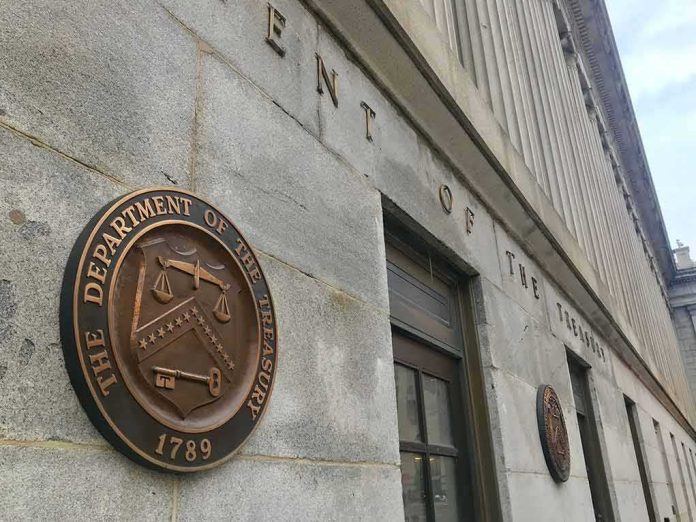
The Treasury Department says it has mapped nearly $15 billion tied to Iran’s shadow banking and moved to choke it off with a sweeping new sanctions round.
Story Highlights
- Treasury flagged about $14.7 billion in financial activity potentially linked to Iran’s shadow banking since 2025.
- New sanctions hit more than two dozen exchange houses, front firms, and personnel tied to these networks.
- Officials describe layered shell companies that moved billions for sanctioned Iranian banks and defense bodies.
- Analysts call it a cat-and-mouse struggle as Iran shifts routes while Washington maps and disrupts them.
Treasury Maps the Money and Targets Networks
The Department of the Treasury’s Financial Crimes Enforcement Network reported about $14.7 billion in financial activity from January 2025 through August 2026 that was potentially linked to Iranian shadow banking. The Office of Foreign Assets Control then sanctioned over two dozen exchange houses, front companies, and key personnel that officials say helped Iran move money despite U.S. sanctions. The action fits a larger push to cut off funds tied to Iran’s state banks, defense sector, and oil trade.
Treasury statements describe how Iranian exchange houses use foreign cover companies and layers of shell firms to hide links to sanctioned bodies. Earlier actions detailed how these channels moved billions of dollars annually for banks already on sanctions lists. Officials also traced tens of millions in transfers in multiple currencies, including Chinese yuan, United States dollars, and United Arab Emirates dirhams, in the 2023 period for defense-linked buyers. The new designations build on that pattern across several jurisdictions.
How the Shadow System Works and Why It Matters
U.S. officials say Iran relies on trusted intermediaries abroad to sell oil, gather foreign currency, and pay suppliers when banks will not touch them. Exchange houses and trading firms set up in places with easy company formation can hide true owners and the end users of funds. These steps help sanctioned banks and agencies access the global financial system without using accounts in their own names, frustrating normal compliance screens and audits.
FinCEN’s trend work and recent designations stress the scale and repetition in this system rather than one-off tricks. In 2024, Treasury highlighted networks serving Iran’s Ministry of Defense and Armed Forces Logistics and the Islamic Revolutionary Guard Corps by routing payments through exchange houses tied to sanctioned Bank Sepah. Later rounds said some exchange houses moved billions each year for sanctioned institutions through layered shell entities across borders. That picture signals a durable structure, not sporadic evasion.
What Changes Now for Banks, Traders, and the Public
The latest action tells banks and payment firms to screen harder for names, owners, and counterparties tied to these exchange houses. Companies working in energy trading, shipping, metals, and machine parts will face more checks and possible payment delays. Some lawful trade could see slowdowns if firms “de-risk” to avoid trouble, a known side effect when sanctions expand. The departments’ messages aim to push risk controls without cutting off allowed humanitarian and commercial flows.
The move also speaks to a wider concern that many Americans share: powerful actors can bend rules while regular people face strict ones. Supporters of tough sanctions see a victory for accountability and national security. Critics worry about broad collateral impact and fewer paths for lawful trade. Both sides often agree on one point: the system needs clear, public facts. Treasury notes the $14.7 billion figure reflects activity “potentially linked,” a standard caveat for trend analysis based on financial reporting.
The Cat-and-Mouse Pattern and What to Watch Next
Officials and experts describe a recurring cycle. Iran builds channels through exchange houses and front firms. U.S. agencies map them and impose sanctions. Networks then shift to new names, owners, and hubs while trying different currencies and routes. Earlier Treasury alerts and designations show this pattern over several years, with new rounds revisiting the same methods as they reappear in updated forms. Results depend on how quickly banks adapt and how well investigators track changes.
Key markers to watch include whether designated firms drop from trade flows, whether replacement entities pop up in the same locations, and whether payment spreads or delays grow for higher-risk goods. Another signal will be how non-U.S. banks react. If they tighten controls, Iran’s options shrink. If they absorb the risk, pressure fades. Treasury’s bet is that steady mapping plus fast designations will narrow Iran’s last big pipelines and raise the costs of evasion.
Sources:
redstate.com, home.treasury.gov