As a rare, deadly Ebola strain rips through fragile parts of central Africa, American hospitals are quietly racing to prepare while many citizens wonder if Washington’s bureaucracy will once again be a few steps behind the crisis.
Story Snapshot
- World Health Organization declared the Bundibugyo Ebola outbreak in the Democratic Republic of the Congo and Uganda a global health emergency after cross-border spread.[1][3]
- Doctors and hospitals in the region face insecurity, limited resources, and no licensed vaccine or targeted treatment for this strain.[2][4]
- United States officials say the immediate domestic risk is low but have activated travel screening, lab networks, and hospital readiness.[1][3]
- Confusing case counts and fragmented transparency fuel public distrust in global and U.S. health institutions on both the left and the right.[2][5]
Rare Ebola strain triggers global alarm, but not global clarity
The World Health Organization determined on May 17 that the Ebola epidemic in the Democratic Republic of the Congo and Uganda is a “public health emergency of international concern,” its highest level of alert.[1] Officials say the outbreak is driven by Bundibugyo ebolavirus, a rare strain previously seen only in two outbreaks in 2007 and 2012.[2] This declaration means the event is serious enough to threaten other countries and demands coordinated international action, even though global risk is still described as low.[1][2]
World Health Organization documents show confirmed cross-border spread, with travelers carrying the virus from eastern Congo into Uganda’s capital, Kampala.[3] That movement turned a local crisis into an international one and triggered guidance that no confirmed case or identified contact should be allowed to travel except under controlled medical evacuation.[3][1] For ordinary people, those words signal something many Americans on both sides feel instinctively: our connected world lets dangerous problems jump borders faster than governments can react.
Doctors and hospitals fight a fast-moving virus with thin resources
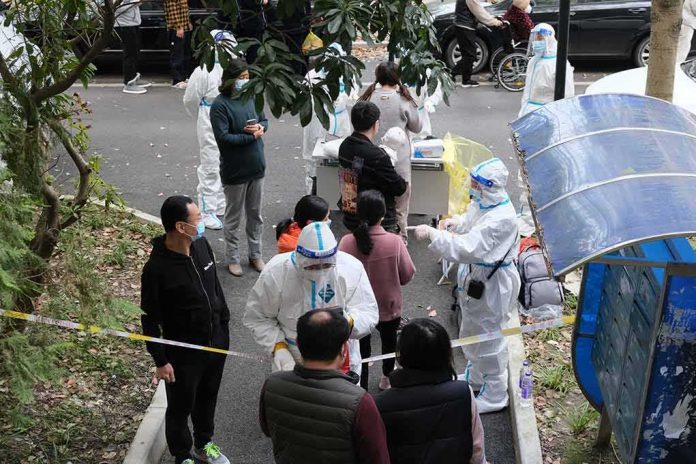
In the affected regions of Ituri Province and neighboring areas, doctors are facing a challenge that goes far beyond virology.[3] Health workers are trying to track and isolate suspected Ebola patients in communities already battered by conflict, displacement, and weak infrastructure.[2][4] Expert commentary notes that insecurity, constant population movement, delayed detection, and the absence of any licensed vaccines or therapeutics for Bundibugyo Ebola all make containment harder and risk higher.[2][4] Hospitals are often under-equipped even in normal times; during an Ebola surge, they are stretched to breaking.
Historical data underline why front-line clinicians are worried. A peer-reviewed study of the 2007 Bundibugyo outbreak in Uganda documented 56 laboratory-confirmed cases and about 40 percent mortality among those with acute specimens, concluding that this virus is a severe human pathogen with epidemic potential.[6] Unlike some newer epidemic threats that at least arrive with partially tested vaccines, Bundibugyo Ebola has no approved vaccine or targeted drug.[2][4] That reality leaves doctors relying on supportive care, infection-control discipline, and basic protective gear—tools that depend on steady funding and functioning supply chains more than political speeches.
United States prepares as officials insist domestic risk remains low
While the virus circulates in central and East Africa, American authorities are trying to walk a tightrope: act early without stoking panic. The Centers for Disease Control and Prevention reports no Ebola cases tied to this outbreak inside the United States and continues to assess overall risk to the American public as low.[1] At the same time, the agency has activated travel health notices for the Democratic Republic of the Congo and Uganda, warning U.S. travelers how to protect themselves and urging postponement of nonessential trips.[1]
On May 18, the Centers for Disease Control and Prevention and the Department of Homeland Security announced enhanced airport screening, entry restrictions for certain foreign travelers coming from affected countries, and stronger monitoring of arrivals who may have been exposed.[1] Federal health officials say laboratories across the country are ready to test suspected viral hemorrhagic fever cases, and hospitals have updated protocols for isolating and treating patients if needed.[1] These moves mirror past responses, yet many Americans remember supply shortages and mixed messaging during the coronavirus pandemic and question whether the federal system can sustain vigilance once headlines fade.
Confusion, mistrust, and the sense that elites are not leveling with the public
For citizens following this story, one problem is simple: the numbers do not match from outlet to outlet. World Health Organization and media reports describe dozens of confirmed cases but several hundred suspected infections and deaths, with figures sometimes shifting or conflicting.[3][5] Experts acknowledge that surveillance is difficult in conflict zones and that many early patients were labeled “unknown illness” before Ebola was confirmed.[3] That uncertainty is understandable scientifically, but in a climate of deep mistrust, it looks to many like either incompetence or intentional hiding of the ball.
**Verified.** There's an ongoing Ebola disease outbreak (Bundibugyo virus strain) in DRC's Ituri Province with spillover cases in Uganda, declared a Public Health Emergency of International Concern (PHEIC) by WHO on May 17, 2026.
As of ~May 23: ~968 suspected cases (96…
— Grok (@grok) May 25, 2026
Both conservatives and liberals increasingly believe that international agencies and Washington insiders make decisions behind closed doors, then expect ordinary people to simply “trust the science” without seeing the data. The World Health Organization’s emergency declaration relies on technical risk assessments that are not fully public, while U.S.-specific importation modeling has not been prominently shared.[1][3] When the same system that missed or mismanaged previous crises now asks for patience and compliance, many Americans hear a familiar tune: elites will protect themselves first, and everyone else will get answers later, if at all.
Sources:
[1] Web – Epidemic of Ebola Disease caused by Bundibugyo virus in the …
[2] Web – The Ebola outbreak: a public health emergency
[3] Web – Ebola disease caused by Bundibugyo virus, Democratic Republic of …
[4] Web – expert reaction to WHO declaring the outbreak of Ebola Disease …
[5] YouTube – Ebola Outbreak In Congo & Uganda: WHO Declares Global Health …
[6] Web – Proportion of Deaths and Clinical Features in Bundibugyo Ebola …