
President Trump’s public tribute put a national spotlight on a wrong-way, suspected drunk-driving crash that killed a veteran bomb technician on Thanksgiving morning.
Story Highlights
- Florida Highway Patrol says a wrong-way driver on Interstate 95 killed Detective Alan Smith in a head-on crash.
- Investigators identified Raul Jonathan Espinoza Martinez and reported he was intoxicated; he was arrested at a hospital.
- The Palm Beach County Sheriff’s Office said Smith was a nearly 20-year veteran and a trained explosives specialist.
- President Trump paused remarks to honor Smith and condemn impaired driving on busy holiday roads.
What Happened on Interstate 95
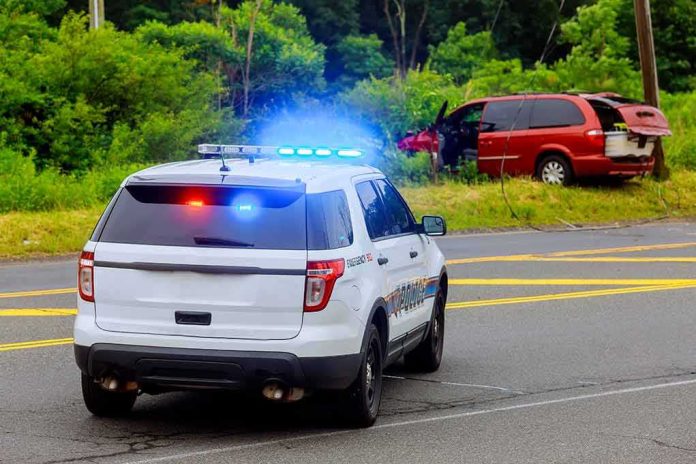
Florida Highway Patrol reported that a Chevrolet Equinox drove north in the southbound lanes of Interstate 95 near Palm Beach Gardens on Thanksgiving morning. The vehicle struck a gray 2017 Ford Expedition head-on, killing the driver, Detective Alan Smith of the Palm Beach County Sheriff’s Office. Troopers identified the wrong-way driver as Raul Jonathan Espinoza Martinez, age 37. They said he was intoxicated and later arrested at St. Mary’s Medical Center on multiple charges tied to the crash.
Authorities listed charges that fit a suspected driving under the influence fatal crash. Reported counts included vehicular homicide, driving under the influence manslaughter, driving with a suspended or revoked license causing death or serious injury, and related reckless driving offenses. Officials said the arrest occurred in the afternoon of the crash day as the investigation continued. Courts will decide legal outcomes, but the listed charges signal how investigators are framing the case.
Who Detective Alan Smith Was
The Palm Beach County Sheriff’s Office identified the victim as Detective Alan Smith, a nearly 20-year agency veteran. The department said Smith served on the Bomb Squad and was trained at the Federal Bureau of Investigation (FBI) Hazardous Devices School in 2013. Reports also said he served as a Bureau of Alcohol, Tobacco, Firearms and Explosives task force officer who focused on explosives investigations. Colleagues described him as a dedicated public servant.
Local reporting said Smith was on duty that morning, traveling in the Ford Expedition when the wrong-way Equinox hit him. The sheriff’s office and area agencies shared condolences and praised his service record. The timing on a major holiday added to the shock for many in law enforcement and in the community. Officials encouraged drivers to slow down and plan safe rides during the holiday period when impaired driving risks rise.
President Trump’s Remarks and Public Response
President Trump paused holiday remarks to honor Smith and call the crash “horrific.” He described Smith as a great police officer and an expert in bombs and explosives. He said the other driver was “really drunk” and traveling on the opposite side of the highway. The president’s comments echoed early reports from Florida Highway Patrol and pushed the local tragedy onto the national stage within hours of the collision.
A man with 3 DUI convictions a 10 year revoked license is now charged with a fatal DUI.
He allegedly killed a Palm Beach detective on Thanksgiving morning.
Let's get into it.
THE CRASH
▪️ Det. Alan Smith, 46, of the Palm Beach County Sheriff's Office, was killed around 5 a.m.… pic.twitter.com/lBiRkuSRCy— Kentucky Girl (@Kentuckygirl1) November 27, 2026
His remarks also fit a broader pattern that safety groups have tracked for years. National Transportation Safety Board research has found many fatal wrong-way crashes involve alcohol-impaired drivers, and most involve front-to-front impacts at high speed. Federal and state reviews link prevention to better ramp design, clearer signs and markings, and fast detection systems that can alert drivers and police sooner. Those steps aim to catch mistakes before they become deadly.
Why Wrong-Way Crashes Are So Deadly
Researchers say wrong-way crashes make up a small share of all crashes on divided highways but cause severe harm because two vehicles often meet head-on. The share of fatal wrong-way crashes tied to alcohol is high compared with other crash types. That is why agencies stress ride plans, ignition interlocks for repeat offenders, and targeted enforcement on ramps late at night and on holidays. These measures are designed to reduce the riskiest moments on the road.
State and federal safety guidance highlights specific fixes that road owners can deploy. Examples include larger and lower “Do Not Enter” and “Wrong Way” signs, better lighting, red reflectors facing wrong-way approaches, and smart sensors that trigger alerts to dispatchers. Studies show these tools can help reduce wrong-way entries, especially where past crashes cluster. Local leaders often pair those steps with public messaging during peak travel seasons.
The Road Ahead in This Case
Troopers continue to investigate how the wrong-way entry occurred and to build the case for prosecutors. Formal evidence such as crash data, medical records, and roadway reviews typically guides charging decisions and any later plea or trial. For the public, the bottom line is clear. Impaired driving on high-speed roads puts everyone at risk, and wrong-way entries are especially unforgiving. Communities will now mourn a veteran detective while the courts process the charges.
Law enforcement leaders often remind drivers to make simple choices that save lives. Do not drive after drinking. Use a ride service, a taxi, or a sober friend. Watch your ramps and signs, especially at night or in heavy holiday travel. Small choices can prevent tragedies like this one. Detective Smith’s record of service underscores what is at stake when any driver heads the wrong way on a busy interstate.
Sources:
facebook.com, cw34.com, wflx.com, primetimer.com, ntsb.gov, ncsl.org, highways.dot.gov